
Combining a flight and a sea crossing in a single itinerary raises a question that traditional travel guides don’t address: what happens when the first leg goes wrong and the second won’t wait? Since Regulation (EC) No 261/2004 was adopted on 11 February 2004, air passengers have had rights in the event of a flight delay or cancellation. These protections do not automatically cover a missed boarding on a separately booked ship.
Recent developments at Europe’s borders add another consideration: the Entry/Exit System (EES), which has been gradually rolled out since 12 October 2025, changes the formalities for some non-European travellers at the external borders of the Schengen Area, including during sea stops.
Flight delays and missed boarding: what EU regulations cover (and what they don’t)
Regulation (EC) No 261/2004 provides compensation and assistance for passengers whose flight is delayed by several hours or cancelled. The airline must offer rerouting or a refund and, in some cases, pay a fixed amount of financial compensation.
These obligations apply only to air travel. If a traveller has booked their flight and cruise with two separate operators, the airline is not required to compensate them for a missed cruise. The boat ticket is covered by a separate contract, with its own cancellation terms. Travellers combining boat and air travel should check this before booking.
The situation is different when the entire trip is purchased as a package holiday under the European Package Travel Directive. In that case, the tour operator assumes overall responsibility, including for connections between different modes of transport. Booking a flight-and-cruise package with a single operator therefore offers protection that two separate bookings do not guarantee.
Allowing enough time between landing and boarding
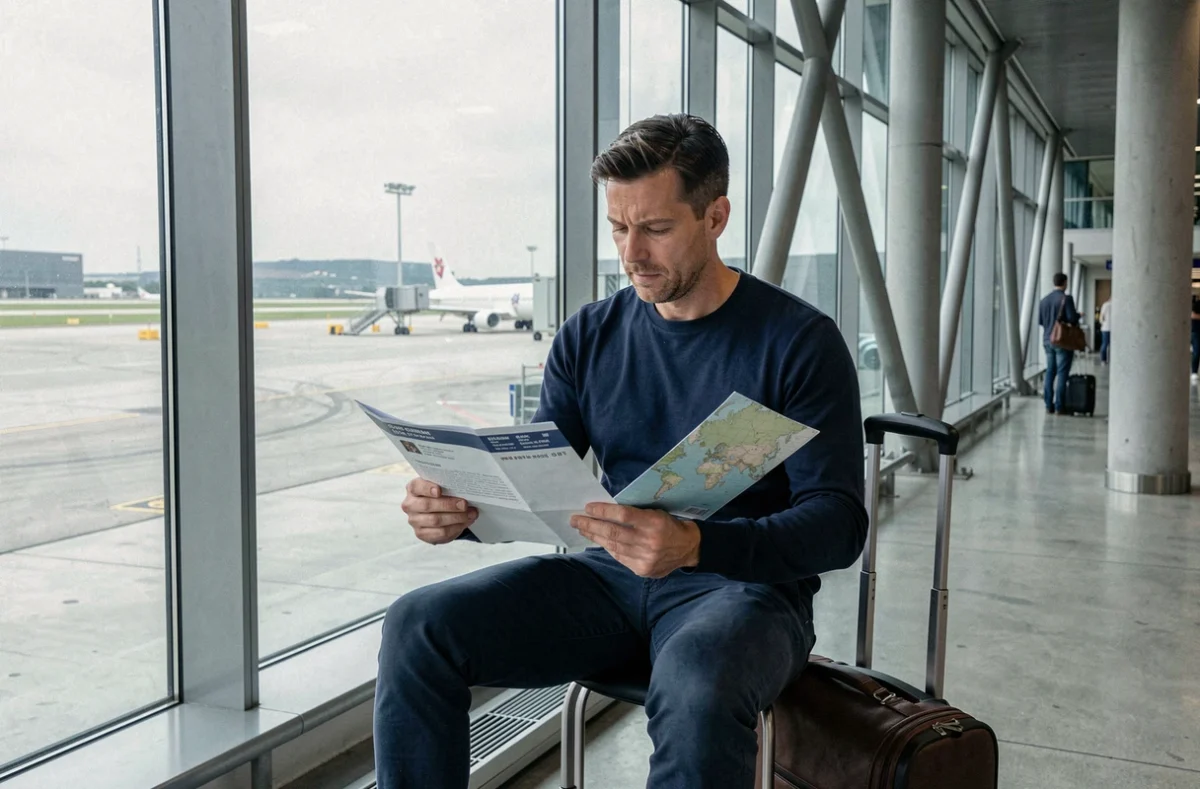
Cruise lines generally close boarding several hours before the ship departs. A flight arriving on the morning of departure leaves little room for delays, missed connections or lost luggage.
Arriving in the departure port city the day before is still the most effective precaution. An extra night in a hotel costs far less than a lost cruise ticket. For itineraries involving a flight connection, doubling the usual buffer between the two legs reduces the risk without complicating the logistics.
Schengen border formalities for a flight-and-boat itinerary
Since 12 October 2025, the European Entry/Exit System (EES) has been gradually recording the entries and exits of certain non-European travellers at the external borders of the Schengen Area. On an itinerary that combines a flight to a European port with a cruise calling at ports outside Schengen, each border crossing may trigger an EES check.
Travellers affected should allow for potentially longer processing times at checkpoints, whether at the arrival airport or at the cruise terminal when returning from a stop outside the area. European nationals are not directly affected by the EES, but changes to queues may increase waiting times for all passengers.
Documents to check based on your planned stops
- Most cruise lines require a passport valid for at least six months after the return date, even for stops within the Schengen Area where an identity card would normally be sufficient.
- Stops outside the European Union (Turkey, Tunisia, the United Kingdom) may require a visa or separate electronic travel authorisation, which must be obtained before departure.
- For itineraries with an air connection in a third country, check whether an airport transit visa is required, even if you do not leave the international transit area.
Carbon footprint of a combined itinerary: the 2026 regulatory framework
Maritime transport is now included in the European Emissions Trading System (ETS) for the large ships covered by the scheme. From 2026, the system will also cover methane and nitrous oxide, broadening the range of greenhouse gases accounted for by shipping companies.
For travellers, this does not translate directly into a tax on the ticket. The impact is indirect: shipowners’ compliance costs may be passed on in cruise prices, particularly for longer itineraries. Comparing two itinerary options (a direct flight plus a short cruise versus a connecting flight plus a long crossing) is therefore an economic as well as an environmental consideration.
The choice of transport mode alone is not enough to determine a trip’s carbon footprint. Distance travelled, ship occupancy, fuel type and time spent on board all factor into the equation. Precise data for individual itineraries can be difficult for travellers to obtain, as not all cruise lines publish their emissions per passenger-kilometre.
Passenger rights reform: what could change in 2027
The European Parliament has been working on a revision of the rules governing passenger rights, potentially covering situations where several modes of transport are combined. The new rules still need formal approval from the Council before they can be published, and would not apply until 23 October 2027.
As things stand, no obligation requires a maritime carrier to cover the consequences of an air delay if the tickets were purchased separately. This legislative development is worth following, but it does not yet establish an enforceable right. Travellers booking a flight-and-boat itinerary in 2026 or early 2027 remain subject to the current rules.
The best way to protect yourself is still to choose a combined package from a single organiser or take out multimodal travel insurance that explicitly covers the risk of missing a connection between two separate carriers. Checking the policy exclusions before departure can help avoid unpleasant surprises when it matters most.