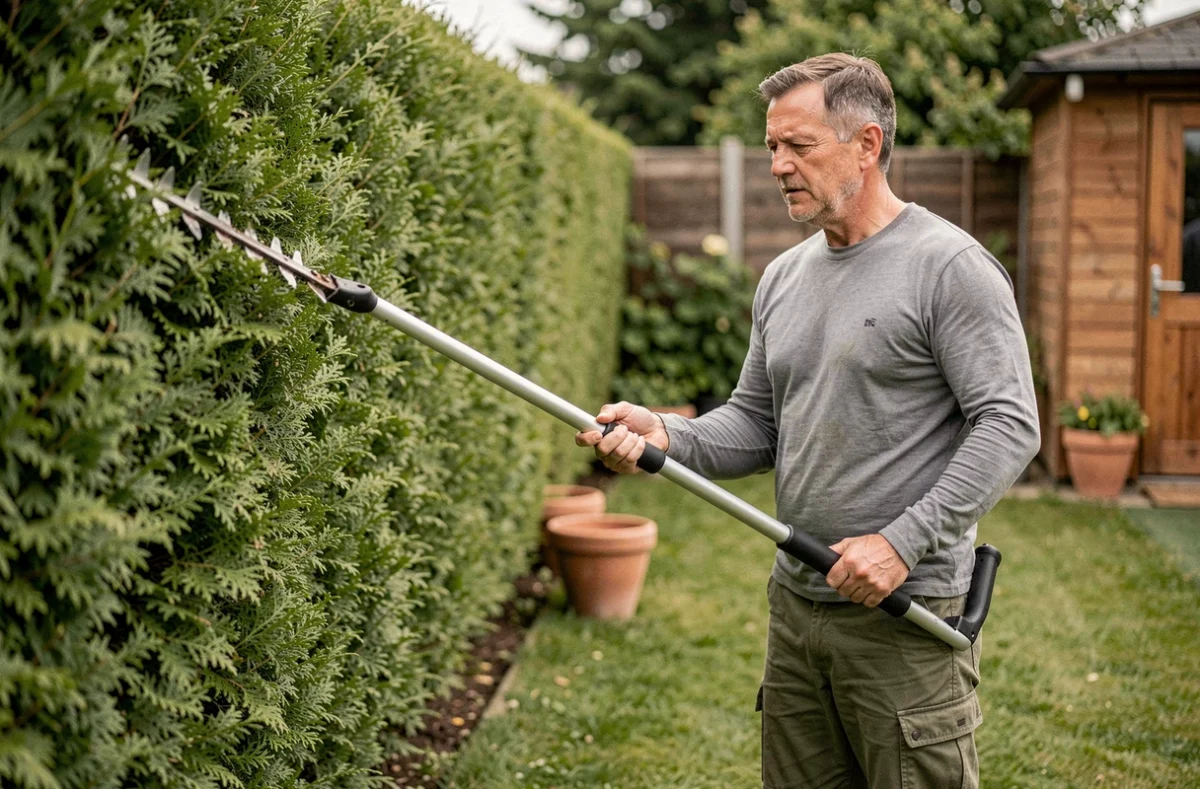
A telescopic hedge trimmer is not just a longer pole than a classic model. The advertised reach, the weight of the cutting head, the overall balance of the tool, and the presence of a harness attachment point radically change the trimming experience. Comparing these parameters among the three main types of power sources allows you to target the model suited to the actual configuration of your hedge.
Actual reach and balance of the telescopic hedge trimmer: what the technical sheet doesn’t tell you
The pole length displayed by the manufacturer gives a theoretical reach. In practice, a pole that is too long increases the torque exerted on the shoulders and degrades cutting precision. The weight of the head, the distribution of mass, and the position of the arms determine the reach you can actually control for more than a few minutes.
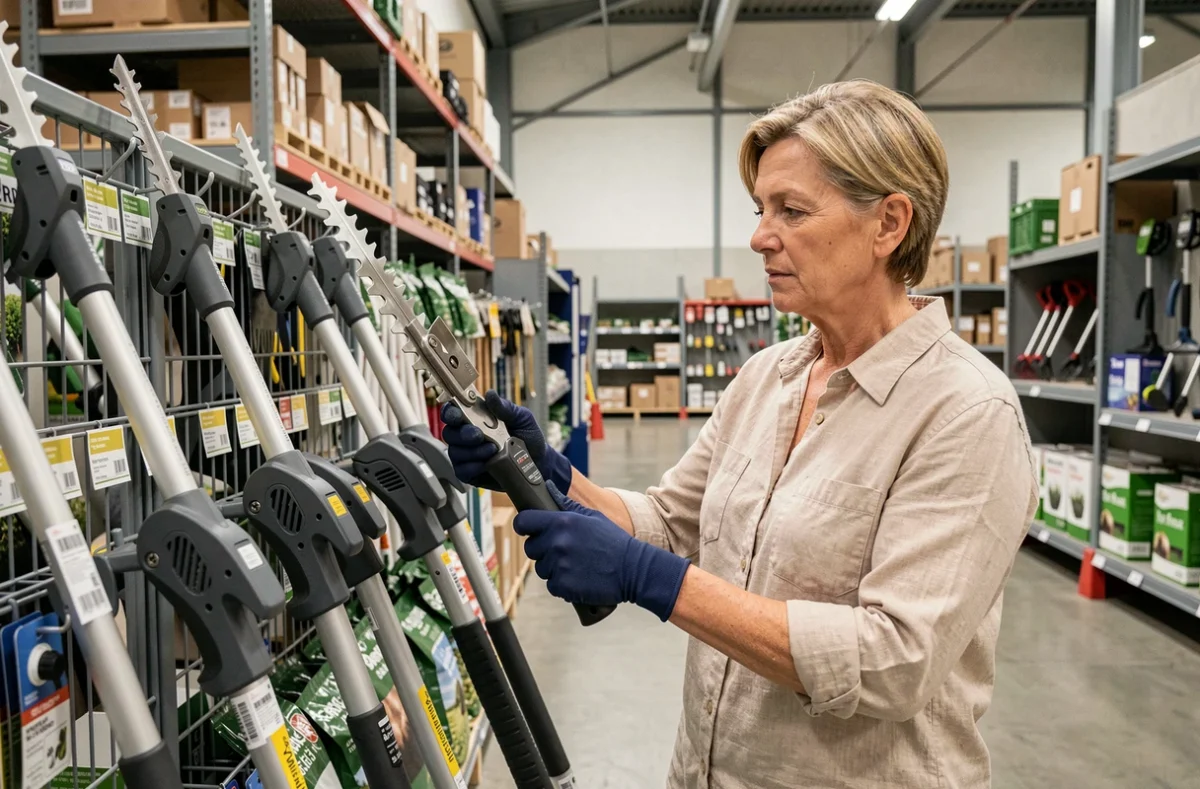
A model with a head that weighs significantly more than another, with the same pole length, will tire the arms much faster. The controllable reach depends as much on balance as on length. Before buying, handle the tool extended to its maximum length and assess whether you can maintain a stable cut for at least two minutes with your arms extended.
The harness and the attachment point deserve as much attention as the power source. A well-positioned attachment point distributes the load across the torso and frees the arms for guidance. On a trimming job that exceeds half an hour, a compatible harness can matter more than a high maximum reach. To delve deeper into the technical specifications of different models, the detailed sheets on taille-haie-telescopique.com allow for comparison of these balance and attachment parameters.
Battery, corded electric, or gas: comparative table of power sources
The three types of power sources cater to distinct uses. The table below summarizes the differences based on the criteria that weigh most in daily use.
| Criterion | Corded Electric | Battery (Cordless) | Gas |
|---|---|---|---|
| Overall Weight | Lightest | Intermediate (battery included) | Heaviest |
| Runtime | Unlimited (mains) | Variable depending on battery capacity | Depends on the tank |
| Cutting Power | Sufficient for common hedges | Sufficient for common hedges | Highest, suitable for thick branches |
| Range | Limited by the extension cord | Free | Free |
| Noise Level | Low | Low to moderate | High |
| Engine Maintenance | Almost none | Almost none | Regular (filter, spark plug, fuel) |
The corded electric model is suitable for hedges close to the house, where a socket is accessible. In contrast, for a large area or without electrical access, the battery offers significantly greater freedom of movement. The gas model is primarily justified for dense hedges with thick branches or for prolonged professional use.
Blade and cutting capacity: adapting tooth spacing to the type of hedge
The blade length and tooth spacing directly affect the result. A short blade provides more maneuverability for complex shapes and topiary. A long blade covers more surface in one pass, reducing working time on a straight hedge.
The tooth spacing determines the maximum diameter of the branches being cut. A spacing greater than 16 mm allows for trimming dense hedges with already woody shoots. For a hedge of thuja or laurels with fine shoots, a tighter spacing produces a cleaner cut.
Double-action blades (both blades move simultaneously in opposite directions) reduce vibrations and improve cutting quality compared to single-action blades. This aspect has a direct impact on the fatigue experienced during prolonged sessions.
- Hedge of conifers with fine shoots: short to medium blade, tight spacing, double action for a clean result.
- Mixed countryside hedge with semi-woody shoots: medium blade, spacing greater than 16 mm to avoid jams.
- Tall and wide hedge (laurel palm, mature privet): long blade, wide spacing, powerful motorization (gas or high-capacity battery).
Trimming period and nesting protection: a constraint often ignored
Buying guides detail the power source and blade but rarely address the trimming calendar. The French Office for Biodiversity recommends that individuals avoid trimming work from early March to late August, the breeding season for nesting birds. Trimming during nesting disrupts broods and can lead to nest abandonment.
Before each intervention, a visual inspection of the hedge is essential. If an occupied nest is spotted, the trimming must be postponed. This constraint influences the choice of tool: if you only trim in the fall and late winter, two times a year, a battery model with enough runtime to complete the job in one session is more relevant than a corded model that requires managing an extension cord along the entire length of the hedge.
Weight, harness, and ergonomics: the criteria that separate a successful purchase from a tool that stays in the garage
A telescopic hedge trimmer that is too heavy ends up not being used. The adjustable head, the adjustable handle, and compatibility with a harness are the three ergonomic elements to check as a priority.
- Adjustable head: allows trimming the top of the hedge without raising the arms above the shoulders, reducing cervical fatigue.
- Adjustable or rotating handle: adapts the grip to the cutting position (lateral, vertical, horizontal).
- Harness attachment point: distributes weight across the torso and frees the arms for precise guidance, necessary beyond twenty minutes of continuous work.
The test recommended by some professional pruners is to hold the hedge trimmer empty, pole extended, and maintain it in position for about ten seconds. If the effort is already uncomfortable when cold, the tool is not suited to your build or the intended trimming duration.
The choice of a telescopic hedge trimmer relies on the match between the actually controllable reach, the type of hedge, and the duration of use. Prioritizing balance and ergonomics over maximum reach avoids purchasing a tool that performs well on paper but is unusable in practice.